


Renata’s command of a multi-location clinic group, where patient engagement apparently had already been solved, is quite impressive. All patients received their portal logins at check out.
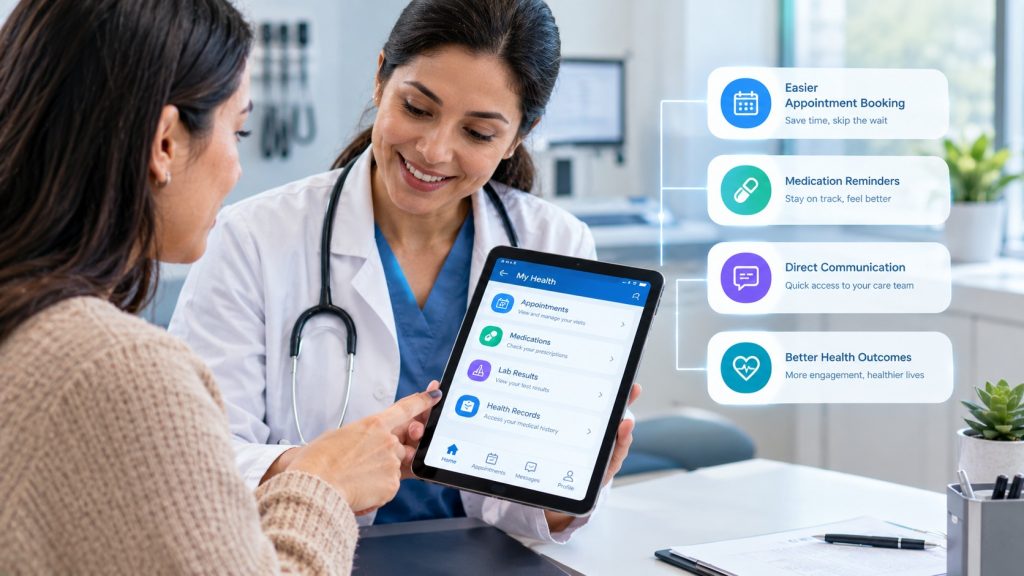
The clinic had gone ahead and invested in a mobile application that included all of the anticipated capabilities, scheduling appointments, safe messaging, test results.
Less than 20% of patients had ever opened it, 18 months after launch. There were no significant changes in the no shows. Consulting the app still left the front desk staff on the phone to double check appointments, the majority of mornings. The technology existed. Very few people were using it and the clinic didn’t know why.
Renata’s clinic is not an exception it’s more aligned with the average in the industry and that’s why more hospital systems and clinic groups are going straight to a healthcare app development company rather than purchasing a generic patient portal and hoping it will get adopted.
A little more than half of America’s 100 largest hospitals already have a mobile health application option available for their patients; and in reality, usage is still in the low single digits at most of these hospitals, which represents a lost opportunity for efficiency and retained revenue of up to $100 million per year in a single hospital system, researchers estimate. It was not difficult to build the app.
The problem with most of these projects is that the patients simply don’t open it or keep coming back.
The Adoption Gap Nobody Budgets For
A health care team that’s building a patient engagement app is typically more meticulous about the build, the features, the security audit, the launch date and less careful about what comes after go-live. That’s upside down—a stark data on actual usage is there.
Patient portals are not widely used: When patient portals are nearly universally available, a significant percentage of patients only log in once, and a much smaller percentage use the portal enough to have any impact on their care.
An app that no one opens doesn’t lead to fewer no shows, it doesn’t quieten the phones at the front desk, and it doesn’t enhance health it was never designed for it to do that. It just sits on a server, it’s a line item that has no return attached to it.
Why Mobile-First Stopped Being a Design Preference
Now, patients turn to the phone for pretty much anything else in their lives and that’s the case with healthcare communication too. Patients now open more than half of their patient emails from a mobile device, and in fact, the use of portal via a dedicated mobile app has been steadily rising as they come to expect the same experience from their clinic that they do from their bank or their airline.
Any tool that’s engineered for a desktop browser that’s then modified later for mobile is all too often going to look like what it is: a retrofit and patients will sense this in the frequency with which they open it up.
Making the phone the starting point for a mobile first approach, and not an afterthought of a desktop portal, is one of the most obvious distinctions between an engagement tool used and one that isn’t.
What Actually Moves the Adoption Needle
The research about what stops the adoption gap doesn’t point to features, but to behavior with the tool. That’s because patients who are actively encouraged by their provider to use a portal or app are using it at significantly higher rates than patients who are given the credentials and left to their own devices, and that difference is evident across all age groups, contrary to the assumption that it is just the older patients who aren’t going to use digital tools.
With implementation, there are measurable improvements in no show rates, through automated recall messages, two-way secure messaging that actually receives a timely response, and digital intake completed prior to a visit rather than in the waiting room.
There is no magic technology that should be used in any of that. It needs an approach that focuses on getting patients to consume what is already built a very different project from making a list of features and hoping they’ll use them.
Why the Investment Is Accelerating Right Now
This isn’t a slow-moving trend anymore. The global market for patient engagement solutions is projected to climb toward roughly $194 billion by the mid-2030s, growing at a compound rate north of 20% a year, and a large share of that growth is being pulled forward by value-based care reimbursement models that tie payment more directly to patient outcomes and experience rather than volume of services delivered.
Research on patient activation, essentially how equipped and confident a patient feels managing their own care, has found that highly activated patients see meaningfully lower rates of hospital readmission within thirty days of discharge compared to the least activated patients.
For a hospital system operating under value-based contracts, that difference translates directly into financial exposure, which is why patient engagement has moved from a nice-to-have communication tool to a line item finance departments now watch closely.
What Actually Drives the Cost of Building One of These Right
A basic patient portal with appointment booking and secure messaging sits at the lower end of what a build like this costs, while a full engagement platform with automated recall workflows, EHR-integrated messaging, and mobile push notifications tied to a patient’s actual care plan runs considerably higher.
Healthcare app development cost scales mostly with how deeply the tool has to integrate with systems that already exist, the EHR, the scheduling system, insurance verification, rather than with how polished the patient-facing screens look.
A build that treats adoption as a design requirement from day one, testing onboarding flows with real patients, building genuinely mobile-first rather than porting a desktop portal, tends to cost more upfront than a bare-bones portal but avoids becoming the expensive, unused app Renata’s clinic ended up with eighteen months after launch.
What Providers Actually Want From These Tools
The concept is accepted by the doctors themselves, only its implementation is not so fast. An overwhelming majority of doctors surveyed believe a well-constructed mobile health tool can actually improve a patient’s outcome, and most say they would recommend using a mobile health tool with their own patients.
The greatest potential for improvement lies in a few problems: getting people to take their medication for a chronic disease, chronic disease more generally, and reminders to schedule preventive care, which otherwise would have to rely on the patient’s memory to schedule something months ahead.
That alignment is important because a physician who actively recommends a particular build during a visit has a better chance of adoption than a build that a physician is not willing to actively recommend when patients are checking out. Some studies report an increase in medication adherence of nearly 18% when a reminder is sent as a text message with a chronic condition, a significant clinical response for such a mundane form of reminder.
The Difference Between a Feature List and a Retention Strategy
It’s worth being blunt about why so many of these builds still underperform despite genuine physician buy-in and real budget behind them: most engagement apps are scoped as a feature list rather than a retention strategy, and those are different projects with different success metrics.
A feature list asks “does the app support secure messaging, appointment booking, and test results.” A retention strategy asks “what happens on day one, day seven, and day thirty after a patient downloads this, and what causes them to open it again.”
Very few healthcare organizations commissioning an app ask the second question with the same rigor consumer apps in other industries take for granted, tracking onboarding completion, day-seven return rates, and where exactly patients drop off, and then iterating the product around what that data actually shows.
A development partner who treats those retention metrics as core requirements from the first product spec, rather than an afterthought measured loosely after launch, is solving a fundamentally different and harder problem than one who simply ships the requested feature list and calls the project finished.
Where Even Well-Built Tools Still Fall Short
Creating technically superb apps doesn’t automatically resolve the problem of adoption, since the adoption barriers that patients report are not necessarily technical. Many patients just like a phone call to a portal message. Some were not walked through what the app does or why it is important to them for their particular care, which research repeatedly identifies as one of the biggest predictors of if a patient logs in again.
But there’s some jams at provider level, too: When the same patient has more than one health system, they often find themselves with multiple disjointed apps versus a single view of their health; Standards-based data sharing between systems is improving over time, but is still not on pace to achieve what a truly unified patient experience would need.
All of this doesn’t imply that technology has failed. It’s only the technology, but it’s not enough, and the systems that are achieving real results are those that invest in building the application, and then actually use the human elements to promote it to patients.
What Changed at Renata’s Clinic
Renata’s team didn’t rebuild the app from scratch. They rebuilt the rollout. Front desk staff started walking patients through the app at checkout instead of handing over a printed instruction sheet, automated reminders replaced a chunk of the manual phone calls, and the onboarding flow got rebuilt around what a first-time user actually needed to see instead of every feature the development team had shipped.
Usage climbed steadily over the following two quarters, not because the technology changed, but because the clinic finally treated getting patients to open the app as seriously as it had treated building it in the first place. That’s turned out to be the real lesson running through this entire category: the hardest problem in patient engagement was never the software. It was always getting a busy, skeptical patient to actually open it.

Leave a Reply