
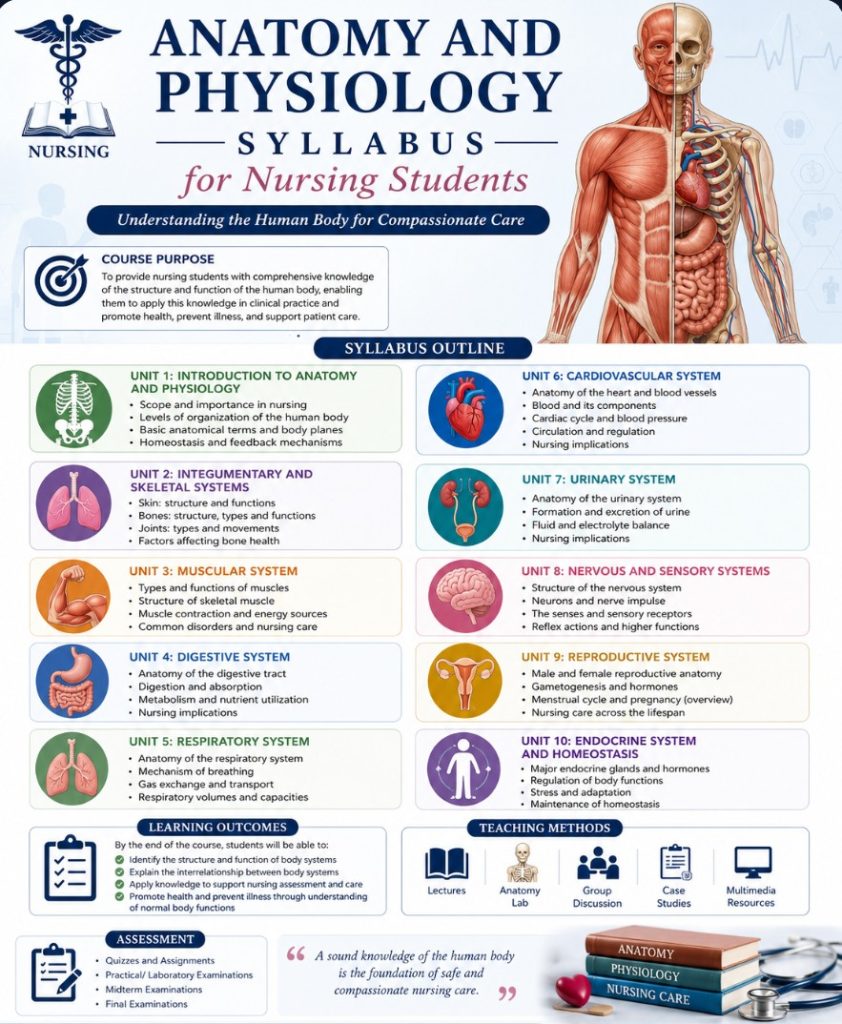



This Anatomy and Physiology Course has been designed to acquire basic concepts and knowledge on human anatomy and physiology of different systems of the human body, which will enable them to apply the knowledge while providing nursing care to the clients.
BSc Nursing COURSE DESCRIPTION
Course Title: Anatomy and Physiology
Placement: First Year
Total Hours: 120
Course Code: BSN 101
Full Mark: 100
Pass Mark: 50
COURSE OBJECTIVES of BSc Nursing Anatomy and Physiology
Upon successful completion of this course, the students will be able to:
- Distinguish between anatomy and physiology, explain the body as a whole, and the different systems of the human body.
- Explain the anatomical position of the body, organs, and cavities.
- Describe the structure and functions of the cells, their characteristics, reproductive cellular genetics, and differences between normal cells and cancer cells.
- Discuss the various types of tissues, their characteristics, and functions.
- Explain the anatomy and physiology of the skeletal system, including joints, cartilage, ligaments tendon and age related changes.
- Describe the muscular system, its types, and the principles of the muscular system, its anatomy and physiology.
- Explain the structure, location, and function of the spleen.
- Discuss the structure of the upper respiratory tract, bronchial tree, lungs, and alveoli, and the function of respiration, including pulmonary ventilation.
- Explain the structure and function of digestion in the mouth, stomach, small intestine, and large intestine.
- Explain the structure, location, and function of female and male reproductive organs.
- Discuss embryology.
- Explain the anatomy and physiology of the central nervous system and the peripheral nervous system.
- State the internal and external structure, location, and function of vision, hearing, and taste.
- Discuss the circulatory system, including blood, the structure of the heart, blood supply, blood vessels, the conduction system, and their functions, including blood pressure.
- Describe the organs related to the lymphatic system, their structure, functions, and immune response.
- Discuss the structure, location, and function of the kidney, nephron, ureter, bladder, and urethra.
- Explain fluid and electrolyte balance in the body and aacid-basebalance.
- Discuss the structure and function of the endocrine system.
- Discuss the structure and function of the integumentary (skin) system.
Anatomy And Physiology Course Syallabus-Bsc Nursing
| Unit | Anatomy Topics | Physiology Topics |
| 1. Introduction | Anatomical terms, body planes, body organization | Homeostasis, body fluids |
| 2. Cell & Tissue | Cell structure, epithelial/connective/muscle/nervous tissues | Cell function and transport |
| 3. Skeletal System | Bones, joints, cartilage | Bone formation and movement |
| 4. Muscular System | Types of muscles, muscle anatomy | Muscle contraction |
| 5. Blood & Cardiovascular System | Heart anatomy, blood vessels | Cardiac cycle, blood circulation, BP regulation |
| 6. Respiratory System | Nose, trachea, lungs | Respiration and gas exchange |
| 7. Digestive System | Digestive organs | Digestion and absorption |
| 8. Nervous System | Brain, spinal cord, nerves | Reflexes and nerve conduction |
| 9. Endocrine System | Endocrine glands | Hormone functions |
| 10. Urinary System | Kidney and urinary tract | Urine formation and fluid balance |
| 11. Reproductive System | Male & female reproductive organs | Reproductive physiology |
| 12. Sensory Organs | Eye, ear, skin anatomy | Vision, hearing, sensory response |
COURSE CONTENTS-Anatomy & Physiology
UNIT I: Body as a whole: organization of the human body cell
- Chemical constituent of cells,
- Structure of the cell
- Physiology of the cell
- Cell reproduction (Mitosis/Miosis)
- Cellular genetics
UNIT II: Human tissue and its types:
- Epithelial tissue, connective tissues
- Muscle, nervous tissue, and its types
- Transplant
- Characteristics, location, function, and formation of tissues
- Tissue repair, membranes gland
- Classification and structures
UNIT II: Skeletal System
- Composition of bone, bone cells
- Organization of the skeletal system
- Bone types, structure, formation, and growth, axial skeleton,
- appendicular
- Skeleton membranes of bone
- Description and function of bone
- Joints classification
- Regulation of bone formation and growth by vitamins and hormones
UNIT III: The muscular system: Skeletal
- skeletal muscle: anatomy of muscle and mechanism of contraction
- Transmission of the electrical impulses to the sarcoplasmic reticulum
- Energy sources for skeletal muscle contraction
- Muscle tone/physiology of muscle contraction, lever, and
- maintenance of posture
- Smooth muscle/cardiac muscle
UNIT IV: Respiratory System
- Structure and function of organs of respiration (alveoli)
- Physiology of respiration, vital capacity, tidal volume, FEC, FIC, RV.
- Mechanism of respiration, exchange of gases in the lungs,
- pulmonary ventilation
- Respiratory problems
UNIT V: Digestive System
- Structure and movements of the alimentary tract.
- Function of different glands involved in digestion, i.e., the liver, the spleen
- and pancreas,
- Composition of food, digestion in the mouth, stomach, and small intestine
- intestine, large intestine, absorption of food.
- Metabolism of protein, carbohydrate, and fat.
UNIT VI: The Excretory System:
- The structure and function of the kidneys, nephrons, ureters, and urinary
- bladder and urethra composition of urine, and the mechanism of
- urine formation
UNIT VII: The reproductive system:
- Spermatogenesis
- Oogenesis, structure, and function of female reproductive organs,
- Structure and function ofthe breast
- Female sexual cycles – Physiology of menstruation
- Introduction to embryology
- Structure and function of male reproductive organs
- Male reproductive organs function in reproduction and fertility
UNIT VIII: Nervous system:
- Structure and function of the central nervous system
- Peripheral nervous system
- Neuralgia and neurons, brain and spinal cord.
- Nerve fiber and nerves.
- Cranial and spinal nerves, location, and function
- Stimulus and nerve impulse
- Definition and mechanism
- Reflex arc, reflex action, and reflexes
- The autonomic nervous system
- Structure, location, and autonomic function
UNIT IX: Sense organ: -Eye
- Somatic, visceral, and referred pain
- External and internal structure of the eye
- Accommodation, physiology of vision
- Binocular vision
UNIT X: Auditory sense:
- structure of the ear, external, middle, inner, physiology of hearing and equilibrium
- Olfactory sense organs, gustatory sense
UNIT XI: Skins:
- Hair, nail, glands,
- Function of the skin
- Temperature regulation
UNIT XII: Circulatory system:
- Blood microscopic structure, formation, composition, and
- function (Haematopoiesis, RBC, WBC, Platelets) blood grouping
- ABO, RH factor
- Clotting factors, Mechanism of coagulation
- Systemic and pulmonary circulation
- Heart structure, conduction system, and functions. Cardiac cycle, cardiac output
Pericardium, wall, chamber, valves, blood supply)
- Heart beat, ECG,
- Structure of blood vessels, arteries, veins, circulation principles,
- control, factors influencing, blood pressure, and pulse
UNIT XIII: Lymphatic system and spleen:
- Component of the lymphatic system and lymph flow
- Function of the lymphatic system
- Immune response
UNIT XIV: Endocrine System
- Structure and functions
- Pituitary gland
- Hypothalamus
- Parathyroid
- Thyroid
- Adrenal gland
- Pancreatic islets
- Pineal gland
- Thymus gland
UNIT XV: Fluid and Electrolytes:
- Intracellular, extracellular, interstitial
- Fluid loss,
TEACHING LEARNING ACTIVITIES
METHODS: Faculty and students in participation
- Lectures
- Discussion
- Demonstration
- Project work
- Presentation
- MEDIA
- White board
- OHP
- Posters, charts, and models
- Skeleton
- CD, video cassettes
- LCD system
- Organ Specimen
EVALUATION
- Class test
- Assignment
REFERENCES
- Stanley W. Jacob.
- Clarice AF Walter J. Lossow, Pl + D, structure and function in man, latest Ed. 1978 Ed, WB Saunders Company, Philadelphia, London, Toronto, latest edition.
- JH. Green, Basic clinical physiology, 3rd Ed., Oxford University Press, New York.
- Arnold Edward, Sears Anatomy and Physiology for Nurses, 1998, 6th Edition, Jaypee Brothers.
- Wilson and Ross, Anatomy and Physiology, 2000. 8th Edition, Churchill Livingstone
- Ross and Wilson, Anatomy and Physiology in Health and Illness, 2001, 9th Edition, London.
- Chatterjee C.C., Human Physiology, Vol. I, II, 1997, 10th Edition, Calcutta, India.
- Guyton A.C., Textbook of Medical Physiology, 2000. 10th Edition, W.B., Saunders.
- Pearce E.C., Anatomy and Physiology for Nurses 1997, 1st Edition – 15 J.P., New Delhi.
- Gupta, Anatomy and Physiology for Nurses, 2004, 1st AITBS Publication.
- Thomas McCracker Richard Walker, New Atlas of Human Anatomy, 1999, 1st Edition, Lustree Press, Roli Books.
- Wilson, K. Ross and Wilson Foundations of Anatomy and Physiology, English Language Book Society.
- Winwood, R.S. Sera’s Anatomy and Physiology for Nurses, English Language Book Society.
- Latest Edition
- Recent Edition to be used





Leave a Reply