


Dr. Anshika Lekhi, MBBS, DGO, Fellowship in Reproductive Medicine, Infertility Expert | TheFertilife, Gurgaon
Endometriosis is one of those conditions that goes unnamed in India far more often than it gets caught – it touches somewhere around 190 million women across the world, and yet the average woman waits between 6 and 12 years before anybody puts the right word to what is wrong with her.
At TheFertilife, we see them all the time: women who have carried painful periods and infertility that nobody could explain for years on end, never once told that endometriosis was the thing sitting underneath it.
So what this guide sets out to do is walk through what the condition actually is, how it gets staged, what it does to fertility, and the whole spread of treatment you can get for it here in Gurgaon.
What Is Endometriosis and How Does It Develop?
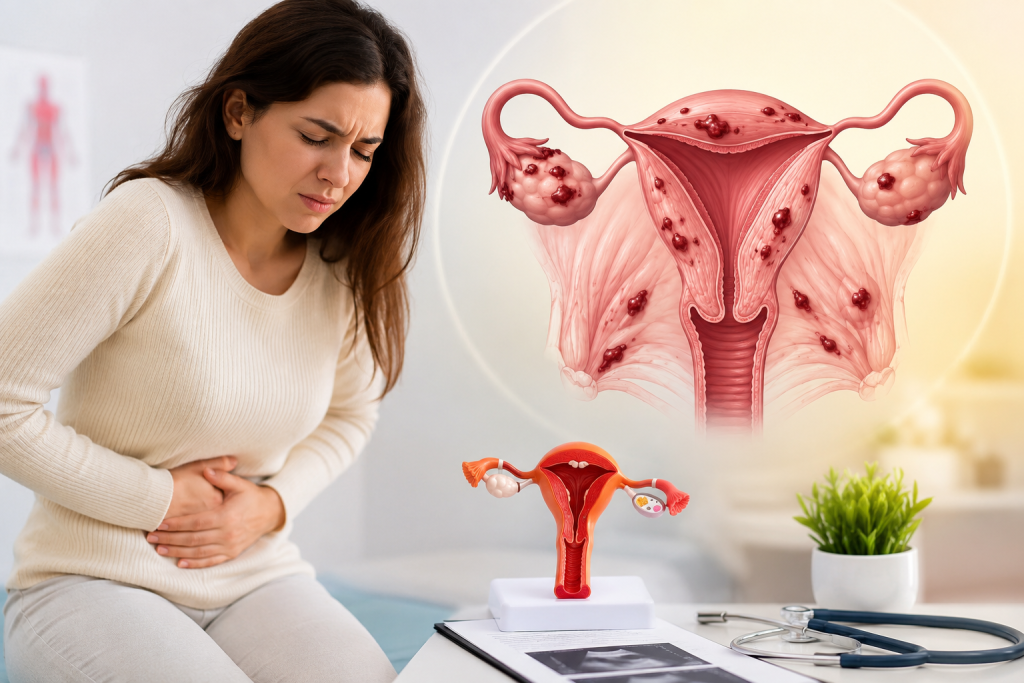
Endometriosis is a chronic inflammatory condition where tissue much like the lining on the inside of the uterus – the endometrium – takes root and grows somewhere it has no business being, outside the uterus altogether. Where it tends to settle is:
- The ovaries: where it gives rise to fluid-filled cysts, the ones called endometriomas
- The fallopian tubes: blocking them and getting in the way of the egg making its journey
- The outer wall of the uterus and the lining of the pelvis
- The bowel or the bladder: in the severe cases, the deeply infiltrating ones
Now the ordinary lining of the uterus sheds every month and leaves the body. This displaced tissue has no way out – none – so it bleeds and inflames its way through every single cycle, laying down scar tissue, the adhesions, and doing steady progressive damage to whatever sits around it.
What Are the Symptoms of Endometriosis?
Here is a thing that catches people out: how bad the symptoms are tells you very little about how far the disease has actually spread. You get women with only the barest trace of endometriosis laid flat by the pain of it, and others whose disease is well advanced feeling almost nothing at all.
- Dysmenorrhoea: period pain that gets worse as time goes on and will not answer to the usual pain relief
- Chronic pelvic pain: a lower abdominal pain that hangs about outside the period entirely
- Dyspareunia: pain during sex, or afterwards
- Dyschezia: bowel movements that hurt, and around the period especially
- Dysuria: passing urine that stings, or having to go far too often, during menstruation
- Heavy periods (menorrhagia): a menstrual flow that drags on or comes far too heavy
- Infertility: it turns up in an estimated 25–50% of the women being looked into for trouble conceiving
If your period pain is the sort that pulls apart your day, your school, your work – that is not normal, whatever you have been told, and it is worth getting looked at.
How Is Endometriosis Staged and Classified?
Gynaecologists lean on the ASRM system – that is the American Society for Reproductive Medicine – and it sorts endometriosis into four stages. Stage I is the minimal end of it: superficial implants, no adhesions worth speaking of. Stage II, the mild, means the implants sit deeper, and minor adhesions are coming in. By Stage III, the moderate, you are looking at multiple deep implants, endometriomas, and adhesions together. And Stage IV, the severe, is the far end – large endometriomas, dense adhesions, the anatomy itself pulled out of shape.
The stage will not always line up with how much pain a woman is in. But it does bear directly on the fertility prognosis and on how the treatment gets planned out.
How Does Endometriosis Cause Infertility?
Endometriosis is one of the leading reasons women end up infertile. And it gets in the way of conceiving down several roads at once, roads that overlap:
- Blocked or distorted fallopian tubes: the adhesions stop the egg being picked up and carried along – women with this often come in already showing the symptoms of blocked fallopian tubes, which sit alongside endometriosis time and again
- Damaged ovarian reserve: the endometriomas eat away at the healthy follicle-holding tissue of the ovary
- Chronic pelvic inflammation: the inflammatory cytokines run high and that impairs both fertilisation and the embryo bedding in
- Reduced egg quality: an ovary inflamed for long enough leaves the oocyte health compromised
Any woman whose infertility has gone unexplained ought to be assessed for endometriosis – even where there is no pain at all to point the way.
How Is Endometriosis Diagnosed?
Laparoscopy
To diagnose it for certain, you need a diagnostic laparoscopy – a minimally invasive procedure where a camera goes into the pelvis so the endometrial implants can be seen directly and biopsied. And laparoscopy pulls double duty, being both the way you diagnose it and the way you treat it – its central role in managing infertility caused by endometriosis means the lesions can be excised and the adhesions released in that same sitting.
Supporting Investigations
- Transvaginal ultrasound (TVS): dependable for turning up ovarian endometriomas, though it can slip past the superficial peritoneal implants
- MRI pelvis: the one you want for mapping out deep infiltrating disease ahead of complex surgery
- CA-125 blood test: it can run elevated, but it is not specific enough to lean on for a diagnosis on its own
What Are the Treatment Options for Endometriosis in Gurgaon?
Treatment gets tailored to the woman herself – her age, how heavy the symptoms sit on her, what stage the disease has reached, and where she stands on fertility.
Pain Management
NSAIDs (non-steroidal anti-inflammatory drugs) are the first thing reached for on pain, and they do their best work when they are started a day or two before menstruation rather than once it has already set in.
Hormonal Therapy
Hormonal treatment works by suppressing oestrogen, which is the thing driving the endometriosis along in the first place. What is on the table:
- Combined oral contraceptives: run cyclically, or continuously
- Progestins: norethindrone acetate and dienogest among them
- GnRH agonists: for the moderate-to-severe disease, and only for a limited stretch, because of what they do to bone density
- LNG-IUS (hormonal coil): good on pain, and with very little systemic effect to it
These hormonal routes manage the symptoms, yes, but they are no good for a woman who is actively trying to conceive.
Surgical Treatment
Laparoscopic surgery – to cut out the lesions, drain and take away the endometriomas, and free up the adhesions – is the call when:
- Hormonal therapy has not managed to hold the pain
- Preserving fertility is the first thing on the list
- Imaging has confirmed structural damage to the tubes or the ovaries
IVF (In Vitro Fertilisation)
Women who do not conceive after conservative surgery, or whose ovarian reserve has run down, are the ones IVF stands to help. The stimulation protocols at a dedicated fertility centre get designed one woman at a time, built around her ovarian reserve and the severity of her endometriosis – because the endometriomas bear directly on how the ovaries respond to stimulation.
This article is for informational purposes only and does not substitute professional medical advice. Please consult a qualified gynaecologist for personalised guidance.



Leave a Reply