
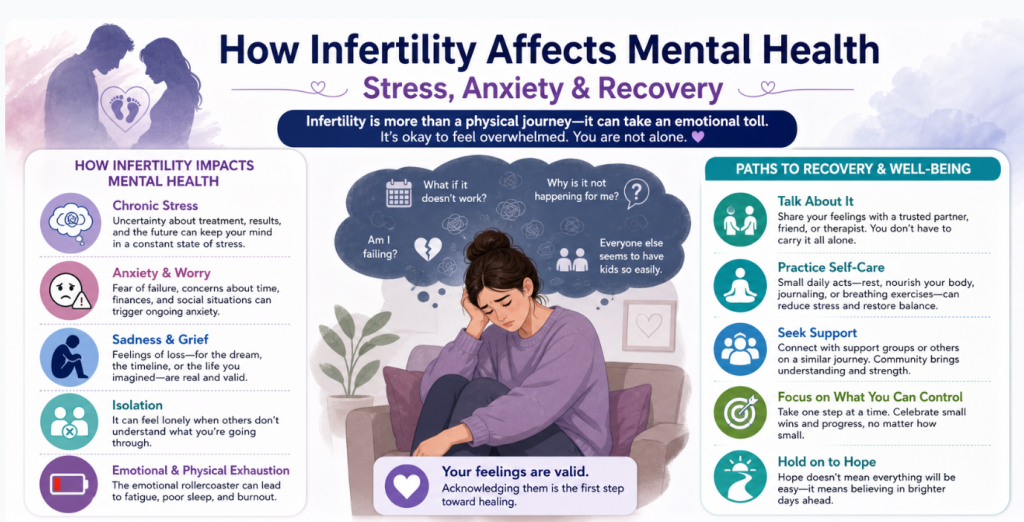



Infertility and Mental Health together are essential for a couple that is having problem for concievieng. Infertility can affect emotional well-being and relationships from the beginning and can last the disaster in some time.
The Emotional Effects of Infertility can be dangerous to single, both of the couple, and also impact families as well as society as a whole. Learn about mental health challenges, stress management, Fertility counseling, and recovery strategies for individuals and couples.
What is Infertility?
Infertility is a life situation not only associated with physical issues but also related to psychological, relationship, family, financial, and lots of social problems. Many infertile couples face the challenge of infertility as they embark on the long and difficult journey to parenthood.
We can define it as the inability of a couple to conceive after a year of regular sexual intercourse without using contraception. However, this infertile situation is more complex than it appears at first glance.
Infertility is a personal matter.
Changing social and lifestyle trends, preponed and postponed marriage, stress in life, and several other factors contribute to increasing rates of infertility. Nevertheless, the psychological burden that comes with it for any couple is often underestimated.
The Invisible Burden
Every couple trying to get pregnant may go through a long and challenging process of testing, treatment, and lots of medication. For the pregnancy, the toll that this takes on their body, as well as the emotional stress, can be overwhelming, especially if the treatment is prolonged. Moreover, the financial burden during the infertility period also increases significantly due to expensive treatments and procedures.
With each failed attempt, the hope for a child may grow more and more. In the same way, there can be a feeling of disappointment with each and every new cycle.
Both members of a couple or an individual person can have this problem. The state of anxiety, sadness, frustration, guilt, and despair, and recurring thoughts of self-blame or depression are the major things to handle. Depression and infertility happen on and off closely. He or she may start to think about whether something is wrong with them or ask themselves why this is happening.
This Infertility Stress can become even more painful when the person sees other pregnant women who are smiling and taking pictures of the newborn babies around them or on social media and among their friends. The more often a person sees happy couples around them with children, the more they may feel overwhelmed with longing for their own child.
This does not mean that they are envious of other people, but rather that their own desires and needs are not being met.
When society adds salt to the wound?
For a person struggling with infertility, constant questions can be very annoying and hurtful to themselves. Following mention things and question by other can aggravate their emotions and feelings.
“When are you going to have a baby?”
“What’s wrong with you?”
“Everybody else has kids, why not you?”
These questions can be asked by family members and close friends, but they can also be overheard by strangers. Infertility Anxiety due to this can occur and can also have bad effects. Family members can also put pressure on the couple by criticizing their decisions or comparing them to other families, that lead more stress in life.
Such type of behaviour can make the couple feel nervous, ashamed, embarrassed, or even depressed. They may start to believe in mitheir nd that they are somehow wrong or defective for being unable to have children. The burden of infertility is personal, and the couple should not feel like they have to explain or justify their situation to others. Society should stop judging and start listening.
Sometimes, the best thing a person can say is “I’m here for you.”
Emotional Effects of Infertility
It’s not just women who have problems.
One of the biggest misconceptions about infertility is that it is a women’s issue in our society.
Although women’s health is one of the major things and the hot cake for the discussions about infertility, the problem canalso beo related to male factors. Something both the male and female factors can be the culprit.
Moreover, male infertility in society is often stigmatized and not discussed openly enough. Women, on the other hand, are often unfairly blamed for the problem, which can be emotionally overwhelming for them.
So, it should be known as a shared problem of both sexes, and it should be treated as such.
When Infertility Affects the Marriage?
The burden of infertility can affect a marriage between the couple by putting a strain on the relationship between husband and wife. The stress raised due to this can lead to misunderstandings and conflicts in their sex life.
The couple may start to blame each other instead of working together to find a solution. The burden of infertility can cause the couple to drift apart, which later leads to emotional distance and even complete separation.
Sometimes, the stress can also become so overwhelming that the husband and wife begin to spend as little time as possible with each other, for example, sleeping in separate rooms, not talking to each other, and not sharing things as well. This is not because they do not care about each other, but it can be because they cannot stand the constant tension and increase the feeling of frustration in daily life.
If the burden of infertility becomes too heavy, the marriage relationship can suffer greatly. In extreme cases, spouses may decide to separate or even divorce because of constant discord and stress. This is the exact reason why infertility should not be a reason for discord between a husband and wife.
The problem is infertility, not each other.
The couple should not fight with each other but instead fight the problem together. They should support each other and try to overcome the challenge as a team by sharing and caring for each other. We should know that physical treatment is essential, but psychological help should also be considered.
The support of a loved one, attentive listening, professional Fertility counseling, and psychological help can be very helpful for a couple struggling with infertility.
Couples can also benefit from frequently talking to each other and openly discussing their feelings and concerns. In addition, people should take care of themselves and, if necessary, resort to professional psychological help.
It is always important to understand that there is no shame in needing help.
When should a person seek help?
It is normal for a person to feel overwhelmed and disappointed when they are struggling with infertility too. However, if these feelings start to affect their sleep, work, and daily life, it is important to know that it is the best time to seek professional help.
Frequent and prolonged arguments with a partner, feelings of hopelessness, generating frustration, and an inability to cope with the situation are also signs that a person needs help.
Seeking psychological help does not mean that a person is weak or incapable of coping on their own. Rather, it means that they should be able to understand that their mental health and careuflly need to take care. Regarding IVF, emotional support should also be known that will help them to reduce the stress and anxiety.
We need to change the narrative around infertility
Infertility should not be a taboo subject in this modern and educated era.
Family members around should not put pressure on a couple, but instead the family should always support them. Partners should listen to each other rather than judge and argue over small and easy things.
Friends and family should also respect the privacy of the couple and keep in mind that they should not ask intrusive questions that can provoke anger. Medical professionals should treat patients with compassion and understand that they need to take care of their mental health as well as their physical health.
Most importantly, we need to stop comparing people by their ability to have children.
A person is much more than their fertility potential.
A Message to People Struggling with Infertility
If you are going through infertility, remember that you are not alone. Many people go through similar experiences, and you should not be ashamed of seeking help. It is okay to feel sad and disappointed, but it is also okay to take care of yourself.
Do not blame yourself for things that are beyond your control. Communicate openly with your partner and seek support from those who care. Remember that infertility does not define you, and that you deserve happiness and a fulfilling life.

Author: RN Anita Budhathoki, Nursing Officer





Leave a Reply